Rendering & GPU / XR & Digital Twins / Shaders / In the Lab · 2025 — present · In development
Solar Farm Digital Twin
Rendering systems for the LSU Solar Farm twin — a compute-shader light-intensity heatmap and GPU PCG growth driven by sunlight.
- Role
- Rendering engineer
- Context
- LSU Solar Farm
- Timeline
- 2025 — present
- Status
- In development
Highlights
- A light-intensity heatmap computed on the GPU and injected into the renderer with a Scene View Extension
- Packaged as a plugin with an Engine Subsystem — no engine modifications
- GPU-side procedural plant generation with Unreal's PCG compute
Overview
The LSU Solar Farm project builds a digital twin of the university's solar installation. I joined in 2025 as the rendering engineer, responsible for two systems: a heatmap that visualizes how much sunlight reaches every part of the site, and a plant generator that will grow vegetation according to that light.
Light-intensity heatmap
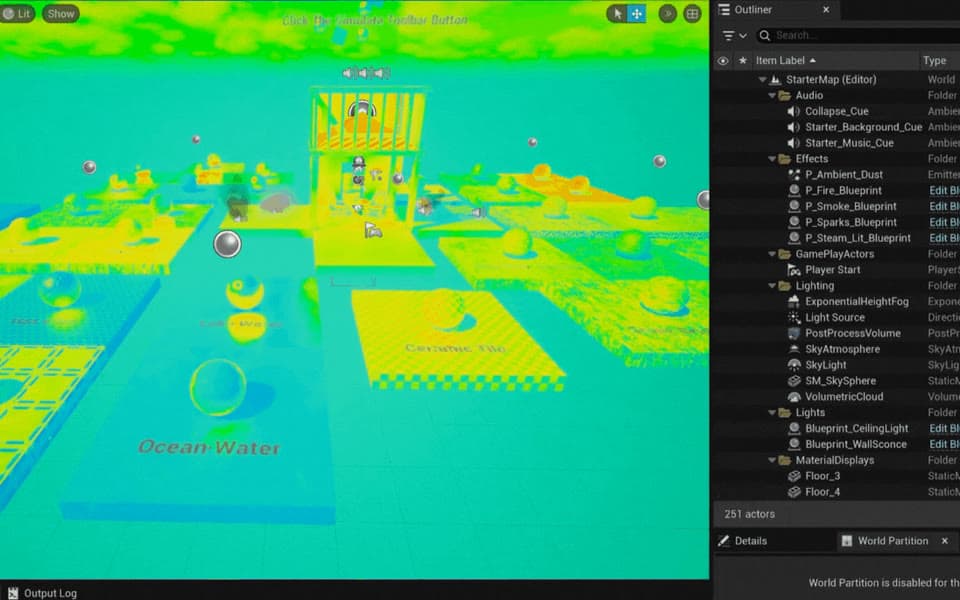
The heatmap reads the sunlight information in the scene and replaces it with colour by intensity: fully lit areas turn red, shadowed areas blue, and everything in between blends smoothly — turning the whole level into a readable map of exposure.
It's a compute shader living inside a plugin. Rather than modify the engine, it hooks into the renderer through a custom Scene View Extension, with an Engine Subsystem managing its lifetime, so it can be dropped into any project.
The view-dependence problem
The first version derives intensity from the GBuffer. That's fast, but the GBuffer only describes what the current camera sees — so the heatmap changes as the camera moves, which is wrong for an analysis tool. I'm now working on a version that estimates light intensity with basic ray tracing, making the result camera-independent and more accurate.
Light-driven plant growth
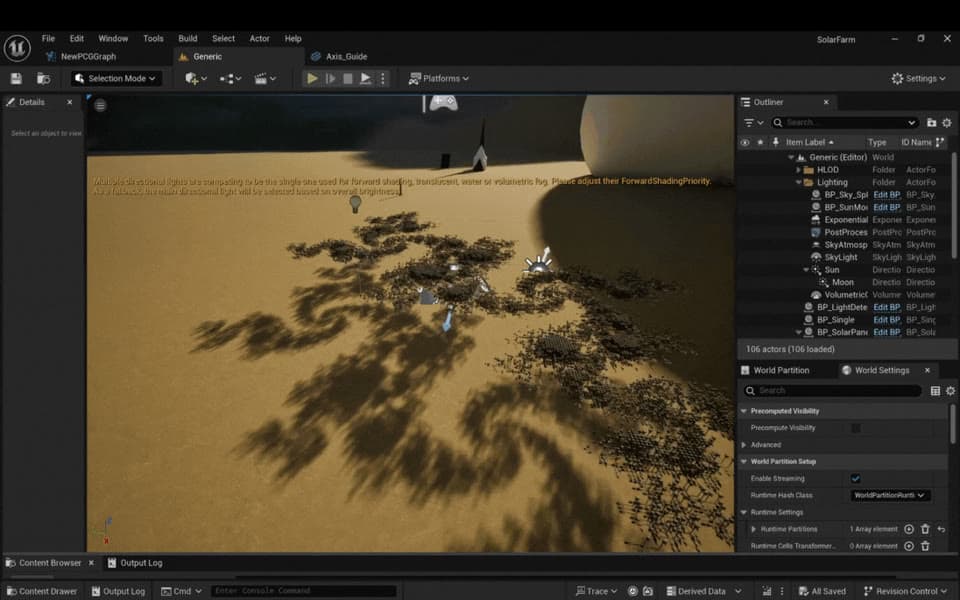
The second system uses Unreal's PCG framework with its GPU compute path. So far I've used it to generate fractal structures directly on the GPU; the next step connects it to the light-intensity data so plants spawn and grow — or shrink back — according to how much sun each area receives.
Credit to renderBucket's PCG Compute introduction for an excellent explanation of the framework.